
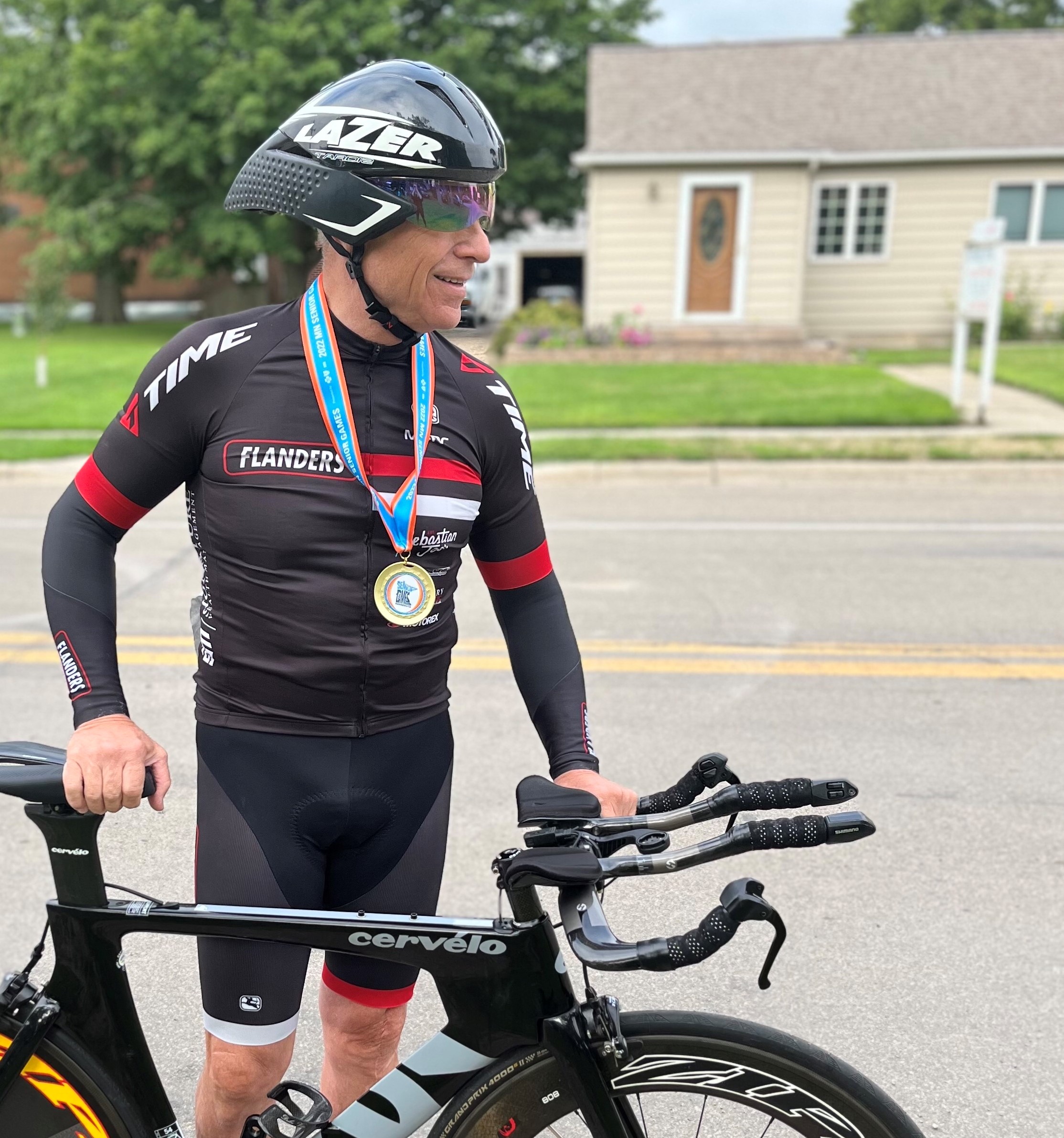
Photo: ready to rock the Minnesota Senior Games Time Trial.
Perhaps you’ve seen them or participated—group fitness classes at the gym. I mean the ones called cross-fit, boot camp, or alpha. The participants generally range in age 20 to 40 moving from exercise to exercise, sweating and breathing hard. These classes are based on principles of high intensity interval training. At age 60, I joined a boot camp class for two years. I was twenty years older than the average age. It kicked my butt, but I learned a lot and use what I learned in my personal training business.
In this edition of What I learned this Week, I write about what is high intensity interval training (HIIT), how it works, why I use it and how I adapt it for clients age 40 to 80.
What is HIIT?
Traditional high-intensity interval training (HIIT) is a training protocol alternating short periods of intense exercise with brief recovery periods until the point of exhaustion. HIIT involves exercises performed in repeated quick bursts at maximum or near maximal effort with periods of rest or low activity between bouts. The very high level of intensity, the interval duration, and number of bouts distinguish it from aerobic exercise, because the body significantly recruits anaerobic energy systems. For more detail on intervals read my article Gaining Fitness, Losing Weight and Slowing Aging with Interval Training
HIIT workouts improve aerobic capacity compared to continuous moderate intensity training. There are also indications that HIIT regimens produce reductions in overall body fat mass. HIIT workouts do not improve muscle mass or bone density. However, if you change the tempo in your strength workouts you can improve muscle strength and aerobic capacity; and reduce body fat.
How does HIIT Work?
HIIT’s crucial features of maximal effort, duration, and short rest periods trigger anaerobic pathways of energy production. Over time, HIIT workouts improve your aerobic capacity and your anaerobic threshold. Your body adapts to HIIT workouts with an improved ability to burn fat and higher aerobic capacity as measured by VO2 max: the best indicator of overall cardiovascular health. For more information on how HIIT works read my article Interval Training: Live Longer, Live Healthier
Although there is no universal HIIT session duration, a HIIT workout typically lasts under 30 minutes in total as it uses the anaerobic energy systems which are typically used for short, sharp bursts. I use intervals of exercise effort ranging from 30 to 60 seconds and vary the duration of the recovery intervals. The point is never allow the body to adapt to a consistent routine—intensity matters.
Why use HIIT?
A HIIT regimen is beneficial for substantially improving VO2 max and overall exercise capacity; with more intense HIIT leading to the greatest cardiovascular improvements. HIIT and interval training are the gold standards for Olympic and professional athletes.
HIIT significantly lowers insulin resistance compared to continuous training and leads to modestly decreased fasting blood glucose levels.
HIIT can result in modest reductions of subcutaneous fat in healthy individuals, but greater reductions for overweight individuals.
Contrary to expectations. HIIT training has a greater effectiveness with lower back therapy than moderate intensity exercise. I have found my clients have a decrease in back pain and an increase in back muscle strength using HIIT workouts.
How I adapt HIIT Workouts for Clients 40 to 80
I adapt HIIT workouts to my clients based on age and fitness level. One size does not fit all. I use four different types of HIIT training with my clients. First, in traditional strength circuit training. I increase the tempo, lower the weight used and shorten the duration of recovery. Second, I incorporate HIIT into circuit workouts with plyometric exercises like jumping jacks or med-ball slams between sets of strength exercises like squats and pulldowns. This makes both the strength and plyometrics harder and more effective. Third, I do 15 or thirty minute HIIT workouts alternating 30 seconds of plyometric exercises with 30 seconds of low impact and low intensity jogging. Finally, I have clients do longer duration high intensity intervals on the stationary bike, treadmill, rowing machine and step mill.
My clients vary in age from 40 to 80; and in ability from beginner to elite master’s athletes. Everyone is different and requires HIIT routines that are safe and challenging. The key is to mix it up. No dull moments in my workouts.
If I can help you improve your fitness workout or help you lose weight with HIIT training, please contact me at steve.crookedthumb@gmail.com
Thank you for reading!

Photo: The benefit of HIIT: second place Bike Time Trial 2022 Minnesota Senior Games.
Leave a Reply to Staying Fit as We Age: Lessons from One of the World’s Best – Crooked ThumbCancel reply