
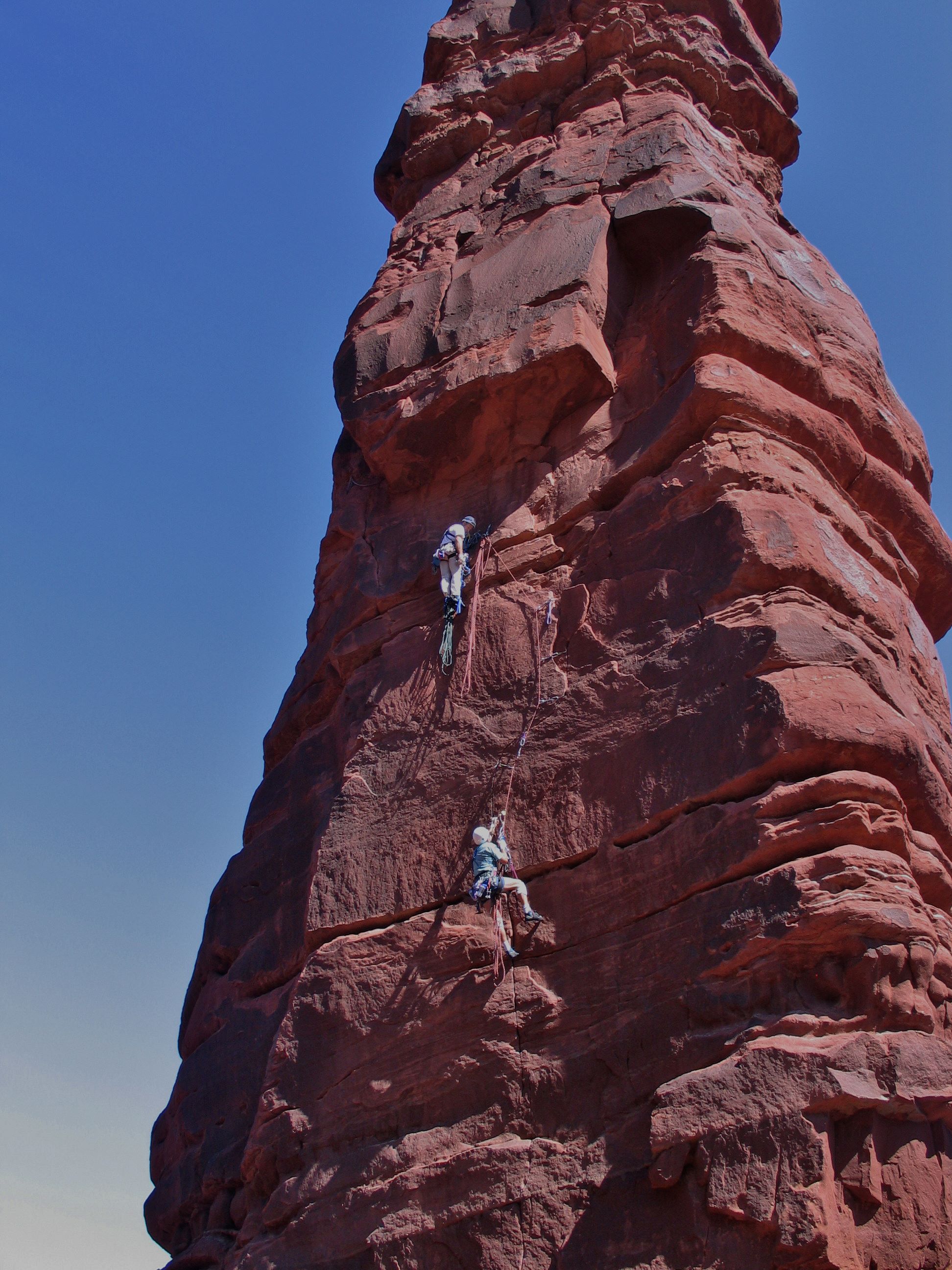
Photo: Paul Gardner and I balanced on the Hindu, Fisher Towers, Utah 2004. Credit: Zeke
Over the years I have had clients with common injuries such as tennis elbow (lateral epicondylitis), knee pain (patellar tendinitis), and heel pain (plantar fasciitis). I have found through my practice these types of injuries are most likely due to overuse, poor posture or incorrect exercise form. Our skeletal muscles are related in a kinetic chain: sometimes one set becomes overused and tight while the other underused and stretched. This muscle imbalance causes inflammation and pain. I cover this in my recent article: Pain: The Body’s Call to Action
For 50 years I have been a competitive and adventure athlete and personal trainer for over 20 years. I know something about pain. In this edition of What I learned this Week, I write about common overuse injuries, the muscle imbalances created, how to repair the damage, and keep the pain from coming back.
Muscle Imbalance
Muscle length and strength between opposing muscle groups need to be in balance for normal movement and function.
There are two primary types of muscle imbalances:
- Body muscular imbalance. The muscles on each side of your body should be symmetrical with each other in size and strength. When a muscle (or muscles) on one side of your body is larger, smaller, stronger, or weaker than the corresponding muscle(s) on the other side, you have a muscle imbalance.
- Joint muscular imbalance. Each of the muscles that surround a joint work together with opposing force that keeps the bones of the joint centered for optimum movement. If one or more of these muscles becomes weaker, stronger, looser, or tighter than normal, you have a muscle imbalance and joint movement can be limited.
Overuse Injuries
Overuse injuries result from repetitive motion creating micro trauma to muscle, tendon, bone or bursa. Excessive loading and insufficient recovery disrupt the natural cycle of inflammatory response and injury recovery. The result is chronic pain. Overuse injuries can originate from poor posture, improper movement, and incorrect form in sports. You may get temporary relief from ice, heat, or ibuprofen. Long-term relief comes from understanding the source of the problem, strengthening and stretching opposing muscle groups and correcting the motion, posture or form.
In the following sections I detail common muscle imbalances that result from overuse injuries.
Lateral (tennis elbow) and Medial (golfers elbow) Epicondylitis
In simple terms, golfer’s elbow is pain on the inside (medial) elbow and tennis elbow is pain on the outside (lateral) elbow. You don’t have to be a golfer or tennis player to get either of these conditions. They are both overuse injuries due to repetitive and incorrect motion. Tight muscles on one side of the forearm and weak muscles on the other side create an imbalance.
For relief, I recommend staying away from the repetitive motions causing the problem. I treat clients with these conditions by strengthening and stretching the muscle on both the posterior and anterior sides of the forearm. I also work to strengthen muscle groups in the shoulder and upper back. If the injury is sports related, I advise my clients to get help from a professional to correct faulty motion.
Patellar Tendinitis
Patellar tendinitis is an injury to the tendon connecting your kneecap (patella) to your shinbone. The patellar tendon works with the muscles at the front of your thigh to extend your knee so that you can kick, run and jump. This is a common injury with cyclists with over-developed quadriceps. The large quad muscles put pressure on the patellar tendon during repetitive pedal stroke resulting in inflammation of the tendon.
I work with clients strengthening the small quad muscles attaching to the tendon using leg extension exercises. We use quad stretching exercises to lengthen the overdeveloped large quad muscles. In addition, we strengthen the hamstring muscles on posterior side of the thigh. I always recommend a visit to a professional bike fitter. The source of patellar tendinitis is often an incorrect bike fit.
Plantar Fasciitis
Plantar fasciitis is inflammation in the plantar fascia in your foot. It’s the most common cause of heel pain. The plantar fascia is a strong, fibrous attachment from your heel to the ball of your foot and your toes. Plantar fasciitis happens when your plantar fascia is overused or stretched too far. Your plantar fascia becomes inflamed making it painful to walk or use your foot.
There are a number of possible causes of plantar fasciitis including, but not limited to, standing for long periods, improper footwear, and running or walking on hard surfaces. Weak or tight muscles in the lower body and core can disrupt proper posture and gait. These imbalances can affect the way weight is distributed on the feet, leading to increased stress on the plantar fascia. When people have postural dysfunction, they often develop compensation patterns in their movements to alleviate discomfort. These compensations can place additional strain on the plantar fascia, increasing the risk of developing plantar fasciitis.
I take a comprehensive approach with clients who suffer from plantar fasciitis. I work to strengthen and stretch the muscles in the core and lower body. It is important to improve posture especially eliminating pelvic tilt. I teach mindful movement: paying attention to your body’s alignment and posture throughout the day. Practice good posture while standing, sitting, and walking to reduce the impact on your feet. Try to eliminate anything that causes pain.
Conclusion
There are other painful overuse/imbalance issues not listed here such as anterior pelvic tilt, bicep tendinitis, shin splints and sciatica. I have practice with all of these. If you are having chronic pain please reach out to me with any questions at mailto:steve.crookedthumb@gmail.com I would be happy to help.

Photo: Fifty years old in 2004. Twenty years later, still surviving overuse injuries and muscle imbalances. Credit: Paul Gardner
Leave a Reply to Mindful Movement: Moving in the Present – Crooked ThumbCancel reply