
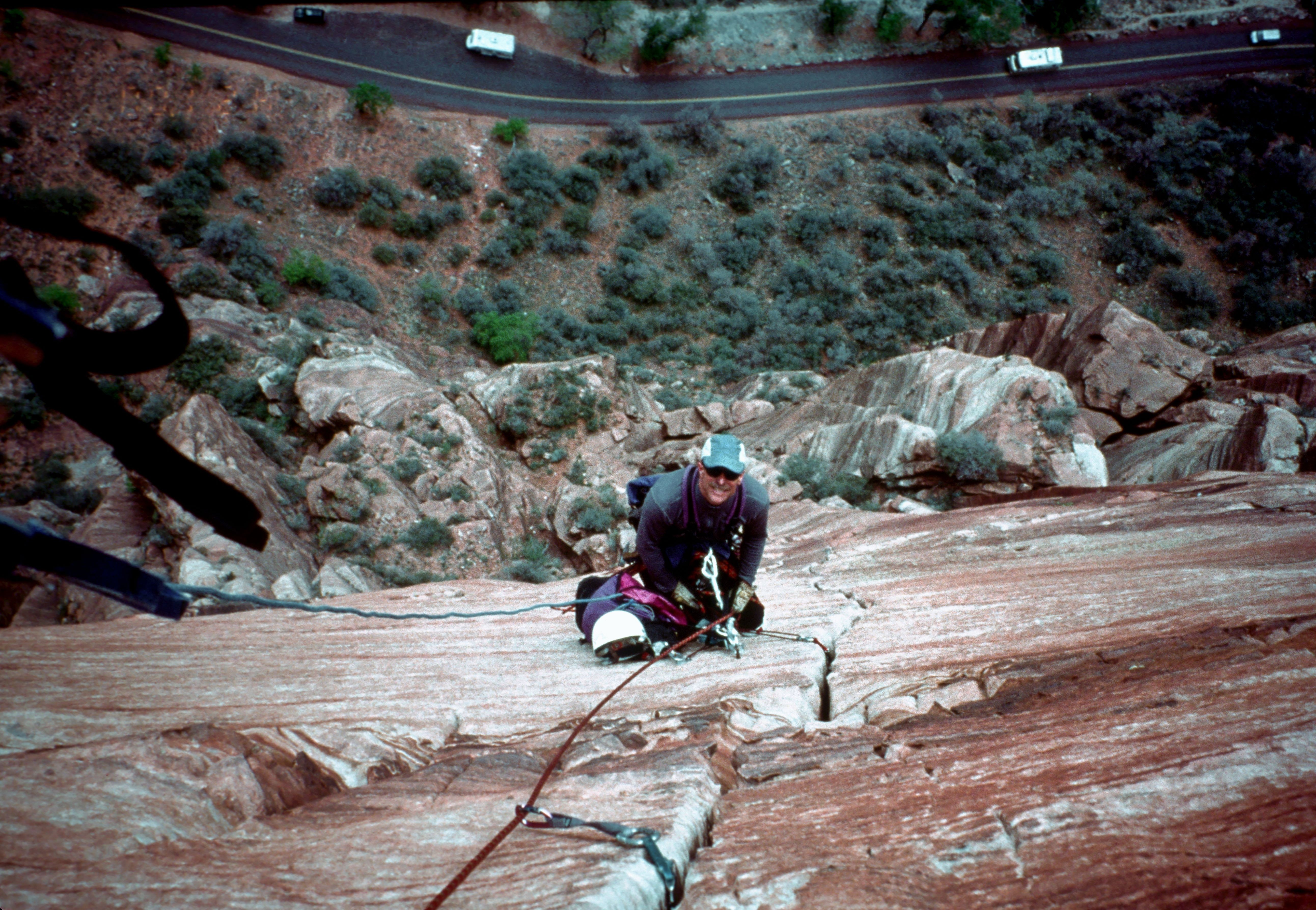
Photo: Achieving goal on Spaceshot, Zion, Utah. Credit: Paul Gardner, 2000
Sitting at my computer, I am listening to the drumbeat of rain on the skylights and day-dreaming about adventure… The position is surreal: a vertical wall split by a single crack. There is no ledge. Called a hanging belay, I am connected to the wall by slings attached to bolts in the red sandstone rock. I could turn and spit… hitting the cars traveling the canyon road 1000 feet below. My partner above is inching his way up a narrow crack. The climb, aptly named Space Shot, ascends one of the vertical rock walls in Zion National Park. To get here, I had a goal, a training plan, and discipline.
This week’s edition of What I Learned the Week is titled Training with a Plan Part One: A disciplined Approach to Achieving Goals. I have clients this year with the following goals: climbing Yosemite’s Half Dome, backpacking in the Wind River Range of Wyoming, river rafting the San Juan River in Utah, competing in Olympic course triathlons, and racing in the Minnesota State Cycling Championships. You achieve better results and increase your margin of safety by having a training plan. Because training plans involve a number of variables, I have separated my article into multiple parts. The next article is titled Training with a Plan, Part two: Light the Fire.
Principles of Training
The science of training is well established. See my article Deliberate Training: Principles of Periodization By subjecting the body to stress, we force it to adapt with positive changes we call fitness. We control three factors in training: frequency, duration and intensity. We use these three factors to overload the body in cycles called periodization.
Training is progressive. We train in cycles or periods. Each cycle has two to three weeks of progressively harder training followed by a week of rest and active recovery. This is called supercompensation. Each active period builds strength, aerobic capacity, and endurance. The rest period allows the body to recuperate, heal and prepare for the next, and harder, active period. Read my article Recovery: The 50+ Athletes Secret Weapon
All my clients differ in age, strength and fitness. Most importantly, they have different family and life commitments that take priority to training. I love working with clients to achieve their goals and help them adapt a healthier lifestyle. Here is a story on training a client to climb the Grand Teton in Wyoming: Gary’s Big Day
Period One: Base Building 2 to 3 weeks
The goal of base building is to discover structural weaknesses, muscle imbalances, nutritional challenges, and base fitness. I recommend a frequency of 3 to 6 workouts per week with at least one full rest day. For most of my clients the duration of each workout varies from 1 to 3 hours. I recommend only one high intensity interval workout per week with time spent above anaerobic threshold limited to ten minutes. For more on understanding interval training and thresholds read my article Interval Training: Live Longer, Live Healthier
Strength Training
Strength training is key for safely achieving your goal. Base building strength workouts are generally slow tempo, high reps, and light to moderate weight. I add 5 minutes each of core exercises and plyometrics to each workout. I recommend 2 strength workouts per week. In the second week of base building, I add more weight and reps; double the core and plyometric workout.
Sport Specific Training
Sport specific workouts should be short to moderate distances at your aerobic threshold: the pace you could hold for a long ride, run or hike. I recommend 2 to 4 sport specific workouts per week. When ready, add some intensity by picking up the tempo or pace. Be conservative! Avoid overuse injuries. Read Balancing Act: Common Overuse Injuries and Muscle Imbalance. Be careful not to over-train! For those prepping for a hike or backpack trip, go easy on the pack weight. At one gym where I used to work, there was a guy training for the Pacific Crest Trail—a BIG hike. He developed a severe case of plantar fasciitis by over-training. He canceled his trip. Beware of burnout!
Nutrition
You cannot exercise your way to lower body fat and weight. See my article Body Set Weight: Why It’s So Hard To Lose Weight. You need to look at you diet and make hard choices. Now is the time. In the base building period, I introduce interval training with the goal of raising your aerobic threshold. This interval training, done at a lower intensity, improves the body’s ability to burn fat as fuel. For more detail, check out my articles Gaining Fitness, Losing Weight and Slowing Aging with Interval Training and Fat for Fuel
Afterword
In three weeks, I am meeting up with my oldest son. We are heading to Zion National Park in Utah. It has been twenty years since I last visited Zion. From the late 80s to the early 2000s, I climbed over a half-dozen of those 1200 foot vertical red sandstone walls. Some of the climbs we did in a day, others we spent up to three days living on the wall. Memories of success and failure; joy and hardship pass through my mind. Max and I plan on doing a one day rock climb, and the next day, a canyoneering descent; two moderate risk, back to back 8 hour days. I can do this at my age because I am lucky to have a good partner and I train for it.
Committing to short-term goals with a training plan has the long-term benefit of putting you on the road to a sustainable and healthier lifestyle. Training is a lifetime journey that doesn’t end when you get to the finish line or back to your car at the trailhead.
Training plans involve a number of variables. My plans are customized for each individual client. If I can help you plan to achieve your goal, please contact me mailto:steve.crookedthumb@gmail.com
Thank you for reading!

Photo: Me and Paul Gardner safely down from Spaceshot. Credit: Unknown Zion Tourist, 2000.
Leave a Reply to Training with a Plan, Part II: Light the Fire – Crooked ThumbCancel reply