
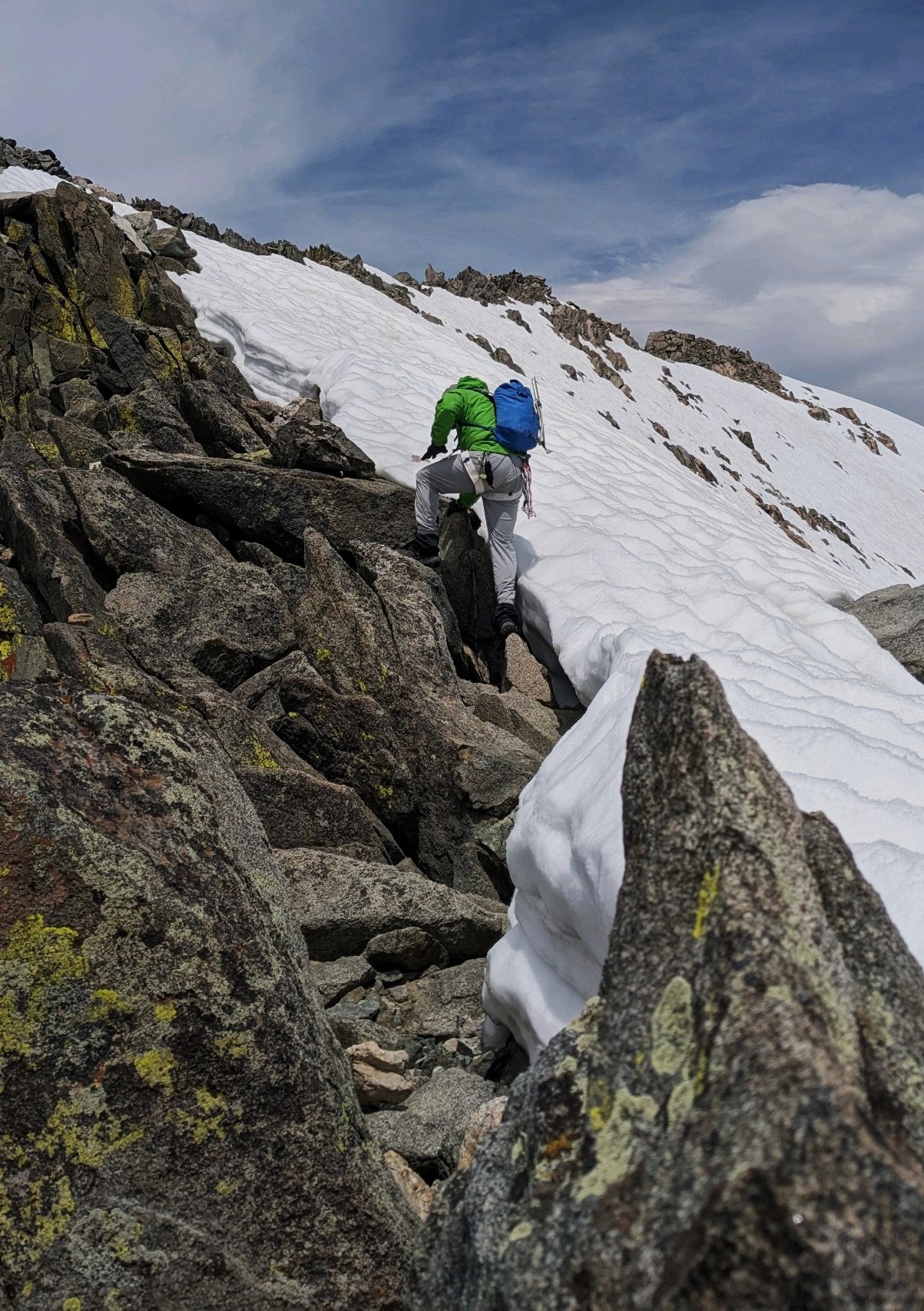
Photo: Climbing mixed alpine terrain to the summit ridge of Gannet Peak on a marathon 18 hour round trip from high camp. Gannett Peak, Wyoming, 2024. Credit Paul Gardner
I look down at my feet planted on the scale. The digital screen reads 161 pounds. Good news? Kind of. Over the last 6 years, I have lost 18 pounds: 6 pounds of body fat and 12 pounds of muscle mass. At times, I suffer from chronic low-level fatigue, lingering muscle soreness and slow recovery from hard workouts. I have attributed this to hard training and advancing age. Several weeks ago, an article in the Washington Post by Alex Hutchinson caught my eye. The title was New Research Says Endurance Athletes May Need as Much Protein as Weight Lifters. Could it be that my problems were not getting enough protein in my diet?
Among my younger weight lifting and body builder friends, the rule of thumb is to consume your weight in grams of protein. That is not easy. At 160 pounds, I would need to consume 4 large chicken breasts or two dozen eggs on a daily basis. I thought at my age (71) I didn’t need that much protein. I also thought on rest day or recovery periods I could lower my protein intake. An article titled Protein Nutrition for Endurance Athletes: A Metabolic Focus on Promoting Recovery and Training Adaptation, based on research out of King’s College in London, says I am wrong on both counts. In my article I will detail what I learned from this new research on protein needs and recommend strategies for protein uptake.
A New Approach to Estimating Protein Requirements
Protein provides amino acids for building new muscle. Protein is also used by our organs in hormone production and by the brain. If you are not getting enough protein, your body cannibalizes protein from your muscle to supply your organs and brain. Lack of protein can hinder post workout recovery and cause fatigue.
Scientists have developed a new, and some think a more reliable, test called the “indicator amino acid oxidation method” for estimating protein requirements. The U.S. government recommends 0.8 grams of protein per kilogram of body weight per day. For a 160 pound adult this is 58 grams per day. The new research indicates that untrained adults should be getting 1.2 g/kg of body weight or 88 grams of protein per day for 160 pound adult. Endurance athletes should aim for 1.8 g/kg of body weight; a whopping 130 grams for a 160 pound adult.
It is hard to consume that much protein. Most of us don’t have the appetite for 100 grams or more of protein. Protein is expensive. For our ancient ancestors it was hard to get. Maybe it’s built into our genetic code to consume less protein as we age—don’t waste protein on the old people. However, the message is clear: if you want to stay strong as you age, recover faster from hard exercise and feel less fatigued, up your protein intake.
Protein Consumption Tactics
Research suggests consuming 0.5 g/kg of body weight of protein following a workout. For a 160 pound individual that is 36 grams of protein. Conventional thinking has been to get that protein immediately after a workout, but there is no convincing data to support this. I actually like to consume 20 grams of protein powder before cycling or Nordic skiing. Then another 20 grams within several hours after working out. I fell noticeably less fatigued after a hard workout.
A big surprise for me is that endurance athletes metabolize more protein on rest days than training days. The latest research indicates that on rest days endurance athletes should aim for at least 2.0 g/kg of body weight. For me at 160 pounds that is 145 grams of protein. It makes sense to me as your repair and recovery functions kick into high gear when you are resting.
Conclusion
I am training hard for the National Senior cycling championships in late July. For the last two weeks I have upped my protein intake to 100 to 110 grams per day. Has it helped? I think it has. This week I did a 10 mile time trial race, a 30 mile easy ride, a moderate strength workout, and a 20 mile hard anaerobic threshold ride. As I write this on Saturday I feel good. Muscle are not sore and I am not fatigued.
In discussing protein intake with my clients, I have found almost all are at the low end of the range on protein consumption; probably in the 50 to 70 grams a day range. I recommend my clients take an inventory of their protein intake and if it is low, give it a boost. Based on this new research, I am targeting four servings of protein per day: 20 grams from a high quality protein; the balance from eggs, dairy, meat, fish or nuts.

Photo: Two old guys age 70 and 75. Gannett Peak (at 13,810 feet, the highest point in Wyoming) August 2025.
Leave a Reply