
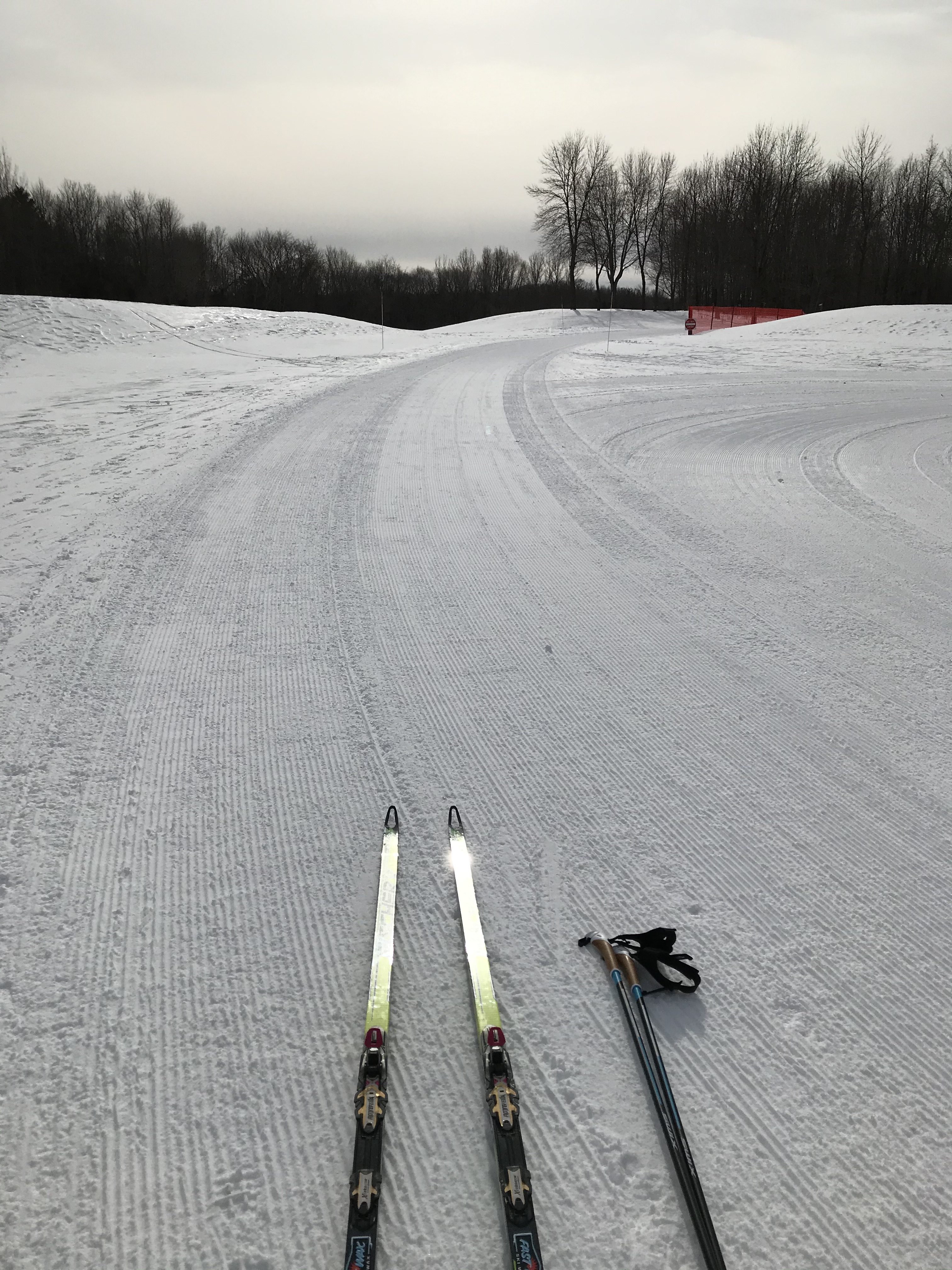
Photo: Ready to put the training to use on freshly groomed corduroy. Baker Park. Minnesota January 2021
It is early November in Minnesota. Winter is coming. In a few weeks, the county parks will begin making snow on the cross-country ski trails. Maybe we will get lucky and have some natural snow this year. I took up skate skiing five years ago at age 66. Learning an athletic skill is hard; frustrating, challenging. My first year, I was the slowest guy on the trail, exhausted each time a got back to my car. Now I routinely log over 300 miles/500 kilometers of skiing in our short three to four month season. No longer am I the slowest guy on the track. This article is about getting ski ready with a pre-season Nordic ski training program.
As a personal trainer, I use periodization training programs to achieve health and fitness goals for my clients and myself. Periodization is based on four principles: individualizing a training plan, progressing that plan over time, adapting physically and mentally to increased workloads, and utilizing training that is specific to the goal or sport. The concept has been around since the late 1940s. Today it is a widely used training guide for both amateur and elite world class athletes.
Building a Base
If you are currently doing regular strength and aerobic fitness training, skip this first section.
The first phase of our training program is base building. In this phase, strength training adapts muscles, tendons, ligaments and joints and for increasing loads. Aerobic/anaerobic endurance training improves the body’s ability to burn fat. Combining the two in progressive workouts builds endurance and prepares your body to handle the increased workload in the strength training phase.
I use free weight and body weight exercises to build strength in existing muscles, not increase muscle mass. Correcting muscle imbalances and addressing old injuries are the key to safe progressions.
Aerobic workouts train your body to preferentially burn fat as a fuel. This is accomplished by doing interval training at moderate intensity. Weather permitting, we are outside rucking (carrying a loaded pack or weighted vest) at the local ski area.
Strength and Aerobic Training
n Nordic skiing you are training for longer duration events, but with short periods of intense activity. With each strength exercise we can vary reps, weight and tempo. I design progressively harder workouts. I think there is great value in mixing up your strength workouts. Workouts might focus solely on legs, upper body, or core. On other days we hit all three. Nordic specific muscle groups include triceps, biceps, and upper back; core with particular focus on lower back and obliques; quads, glutes and hamstrings.
Aerobic workouts are dominated by interval training with the emphasis on improving cardio vascular capacity. I use different duration, high intensity intervals (HIIT) to build VO2 max, speed, and acceleration.
The purpose of strength training is to improve your mental and physical ability to handle stress. Training research shows that subjecting the body to stress at all age levels, improves fitness, overall health, and slows the aging process. Subjecting the body to stress prepares you for real time winter adventures.
Active Recovery
Achieving athletic goals requires a capacity and affinity for hard work. Successful athletes train hard, but smart. As workload or age increases, the need for rest and recovery accumulates. Continuously hard workouts reach a point of diminishing returns. When you hit that tipping point you need to step back and let your body and mind recover. Recovery is one of the most difficult aspects of training to get right. In planning recovery periods, you need to answer the questions how, when, and how long. The sooner you recover, the quicker you can get back to training hard.
During recovery, the body realizes changes in form. These changes include improved fat burning and decreases in body fat; stronger and more resilient muscles and tendons; greater heart stroke volume; increased lung capacity; increase in muscular capillary density; and enhanced glycogen storage. Allowing this adaptation sets the stage for an increase in workload in the next training stage.
Power and Sport Specific Training
As we approach the opening of ski season, we combine strength training and power training. An example is a super-set of moderate weight squats for strength; adding step ups for endurance and box jumps for power. The exercises mimic the repetitive movement of skiing and are designed to make you stronger, improve your muscular endurance and develop your fast twitch muscles. Power is important in endurance sports. It gives you a reserve to call upon in times of stress.
The Taper
If you are training for a competition or adventure trip, it is important to spend the last week in recovery mode. I recommend short duration light weight all body strength workouts, low intensity aerobic workouts; stretching and yoga. Stay hydrated and cut back on your calorie intake. Get psyched!
Afterword
Fitness programming works. Decide who you want to be and become that identity. Be a realist. Identify your problems and barriers to success, then confront them. Create a plan to achieve your goals and measure your progress. Execution is the key. Practice good work habits. Don’t worry about your goal, focus on the process of achieving your goal. See my article Creatures of Habit: https://crooked-thumb.com/2020/10/28/creatures-of-habit-small-changes-big-results/.
If you are looking for help training or coaching, or if you have any questions, please reach out to me at mailto:steve.crookedthumb@gmail.com. Thank you for reading.

Photo: First tracks, Baker Park, Minnesota January 2021.
Leave a Reply