
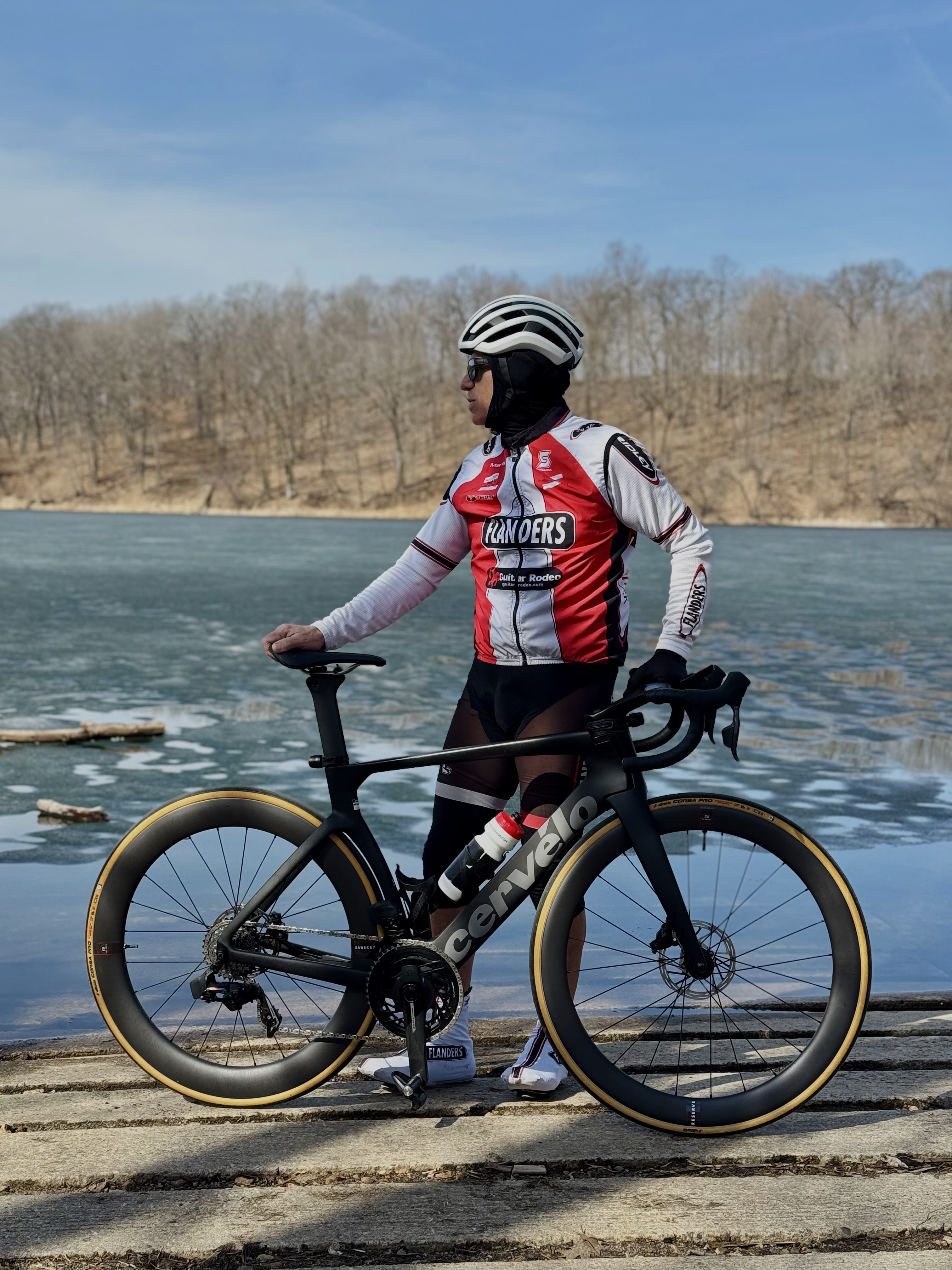
Featured photo: March 2026 ride four weeks after my skiing accident. Credit Charlie Markusen
Each pedal stroke brings a shot of pain behind the kneecap, medial side and back of my knee. It is March 2026 in Minnesota, a cruel month for cycling made worse by a February skiing injury. The midday sun is low in the sky, ice covers the lakes. The Minnesota State Cycling champs are months away, but my knee is going to take a long time to recover from the trauma of my accident. After the ride, I check my stats: distance 20 miles, average speed 13.5, average power 110 watts, left/right power balance 44% injured right leg, 56% left leg. I have a lot of work ahead: progress not perfection.
In my 2022 article https://crooked-thumb.com/2022/11/21/the-long-way-back-recovering-from-traumatic-injury-or-major-surgery/ I wrote about what it takes to recover from trauma. In this article, I detail the latest research on injury recovery protocol, and relate my own experience dealing with injuries and helping clients as a personal trainer.
It is hard work recovering from trauma of any kind. Perhaps more so mentally and psychologically than physical. It’s easy to say this sucks, it hurts, I’m never going to be the same. Yes it does suck, but this is your journey, breathe into it. Yes it hurts, but that is the price you pay. You can’t buy recovery with money. It costs sweat, pain and sometimes tears. It is true you will never be the same, but it is your chance to learn, grow and become a better version of yourself.
Current Orthopedic Injury Recovery Guidance
There’s been a real shift in orthopedic injury recovery guidance over the past decade, moving away from older “rest until it stops hurting” thinking. Here’s where the evidence currently stands:
From RICE to PEACE & LOVE
The old RICE protocol (Rest, Ice, Compression, Elevation) has largely been replaced in current sports medicine literature by PEACE & LOVE:
• Protection (avoid activities that increase pain for the first few days)
• Elevation
• Avoid anti-inflammatory drugs (there’s growing concern that NSAIDs in the acute phase may blunt the natural healing response, though this is still debated)
• Compression
• Education (about realistic recovery timelines)
Then, after the acute phase:
• Load (return to normal activities as early as tolerated, guided by pain)
• Optimism (psychological state genuinely affects recovery outcomes)
• Vascularization (cardiovascular exercise to boost blood flow to injured tissue)
• Exercise (restoring mobility, strength, and proprioception)
Ice is contested. Newer research questions whether icing actually speeds healing versus just numbing pain — inflammation is part of the repair process, and suppressing it too aggressively may not help long-term tissue remodeling. This is still an active debate, not settled.
Early controlled loading beats prolonged immobilization. For most soft tissue and many bone injuries, the data increasingly favors early, progressive mechanical loading over extended rest — this applies to tendons, ligaments, and even some fractures (within limits set by the treating clinician).
Individualized, criteria-based progression rather than fixed timelines. Return-to-activity decisions are increasingly based on functional testing (strength symmetry, range of motion, hop tests, etc.) rather than “6 weeks post-injury.”
Sleep and nutrition are getting more attention — adequate protein intake and sleep quality are now recognized as meaningfully affecting tissue repair rates, not just “nice to have.”
A Good Day goes Bad
As the altitude decreases, the snow pack changes: 20 inches of fresh powder at 10,000 feet becomes 12 inches with a wet buried crust at 8000 feet. It is February 2026 in Grand Teton National Park and I’m alone on a 4000 foot vertical backcountry ski run named Mavericks. The snow is fast, I try controlling my speed, pushing my skis deep, they catch, I barrel row, but the tails get caught in the wet crust. My bindings fail to release. I hear/feel the sound of my knee ripping. Movement stops. Head downhill, my skis are uphill buried in wet cement. Slow down, breathe, don’t panic. Slowly, carefully, I’m able to release my bindings.

Photo: perfect snow on Upper Mavericks, GTNP February 2026
Free from my skis, I stand taking stock: my right knee is compromised, it is 3 pm, three hours of daylight, another 500 vertical feet of skiing to the valley floor, and then two miles of flat track to the car. I have a choice: ski out or call for a rescue. Two hours later breathing a big sigh of relief through a cloud of pain. I reach the car.
A week later I’m visiting with my orthopedic surgeon. No torn ligaments, but a Grade II sprained medial collateral ligament and a Grade II strained hamstring. Both of which have aggravated the arthritis on my knee behind the kneecap. I walk out on light feet: relieved to avoid surgery, but relief is tempered by the reality of months of hard recovery.
Recovery Protocol for Ligament Sprains
Ligaments connect bone to bone. Graded by damage:
• Grade I (mild stretch): ~1-3 weeks
• Grade II (partial tear, some laxity): ~3-6 weeks
• Grade III (complete tear, instability): ~2-3+ months, sometimes surgical
Phase 1 (Days 0-3): Brief protection (brace/taping), compression, elevation. Gentle ROM as tolerated — not full rest. Weight-bear as pain allows; crutches only for Grade II-III.
Phase 2 (Days 3-14): Progressive ROM, isometric strengthening. Start balance/proprioception work early — sprains impair joint position sense even after pain fades.
Phase 3 (Weeks 2-6+): Progressive resistance training, sport-specific movement, balance/agility drills (single-leg stands, wobble boards, cutting). Return-to-activity based on ~90% strength symmetry and pain-free functional testing, not a calendar date.
Key point: Proprioceptive training is one of the strongest predictors of avoiding re-injury — chronic ankle instability usually happens because this step gets skipped.
Mid-Season Reality Check
It is early June. Crossing the finish line of the time trial cycling race, I pull over to the side of the road to check my stats: distance 10 miles, average speed 20.2 mph, average power 169 watts, left/right power balance 50/50. Not ideal, but progress.
Riding progress comes from longer intervals and more intense intervals; always paying attention to my left/right power balance. I hike once or twice a week as a cross training exercise and to train for an August adventure in the mountains of Wyoming. I keep my heart rate in the fat burning zone and gradually increase my pack load now at 20 pounds.

Photo: Ready for a Time Trial race, June 2026. Credit Brett Levas
Strength training is critical to injury recovery. I focus on one leg strengthening exercises that address the three weaknesses in my right leg: medial ligament, hamstring and femur arthritis.
Recovering from numerous injuries starting at age 14 has imbued me with mental toughness. It’s another injury, another job. Get it done. I know I have do it. Progress comes from hard work and visualizing a successful outcome.
Recovery Protocol for Muscle Strains
Graded I-III, different biology and recovery curve than ligaments:
• Grade I (mild overstretch): ~1-2 weeks
• Grade II (partial tear): ~4-8 weeks
• Grade III (complete rupture): often surgical, months
Phase 1 (Days 0-5): Relative rest from the aggravating movement (not immobilization). Gentle isometric contractions can often start within days to reduce pain and maintain activation. Compression/elevation as needed.
Phase 2 (Days 5-21): Pain-guided stretching, light concentric exercise, then gradual eccentric loading — the strongest evidence-backed intervention for strains specifically (e.g., Nordic hamstring curls). Light cardio to maintain fitness without stressing the tissue.
Phase 3 (Weeks 3+): Reintroduce high-speed, high-force movement (sprinting, cutting, heavy lifting) last. Return-to-play testing should include strength symmetry AND pain-free maximal-effort movement — re-injury is common when this stage is rushed.
Key point: Re-injury rates (especially hamstrings) are high because people return once pain resolves, but before eccentric strength and high-speed capacity are truly restored. Pain-free arrives well before tissue-ready.
Race Day
It is August 8th. The rider ahead of me gets the signal to start. Moving forward, I take my place at the start of the 2026 Minnesota Senior Games 10k Time Trial, the first of four cycling events over two days. Countdown, then launch for six miles as fast as you can go; just you against the clock for 17 minutes of pain. As Tour de France legend Jens Voight said, “Shut up legs.” My body is screaming at me crossing the finish. I look at my stats: 6.26 miles, 21.9 mph average speed, 181 average watts, and average heart rate of 144 bpm. Best ride of the year and good for third place. Next up: 20K Road Race.
I end up with four podium finishes in all four races. No golds. The guys that finished ahead of me I have beaten before, but not this year. It is a small group that are still racing in their 70s. The guys that beat me earned it; they worked hard. I respect them and I’m truly happy for them.
It has never been about winning and the medals for me. The medals sit in the basement on my bike rack. It’s about the journey—transforming an aging body and mind into a competitive machine. It’s about living in the moment to find happiness and serenity. I am proud of what I did this year. The skiing accident was a bummer, but I learned from it. The recovery sucked, but I am a better person for it. Progress, not perfection.

Photo: 2026 Minnesota Senior Games hardware, Credit Sarah Pak
Please contact me at mailto:steve.crookedthumb@gmail.com if I can help you recover from, or help you prevent an injury. Thank you for Reading.


Leave a Reply