
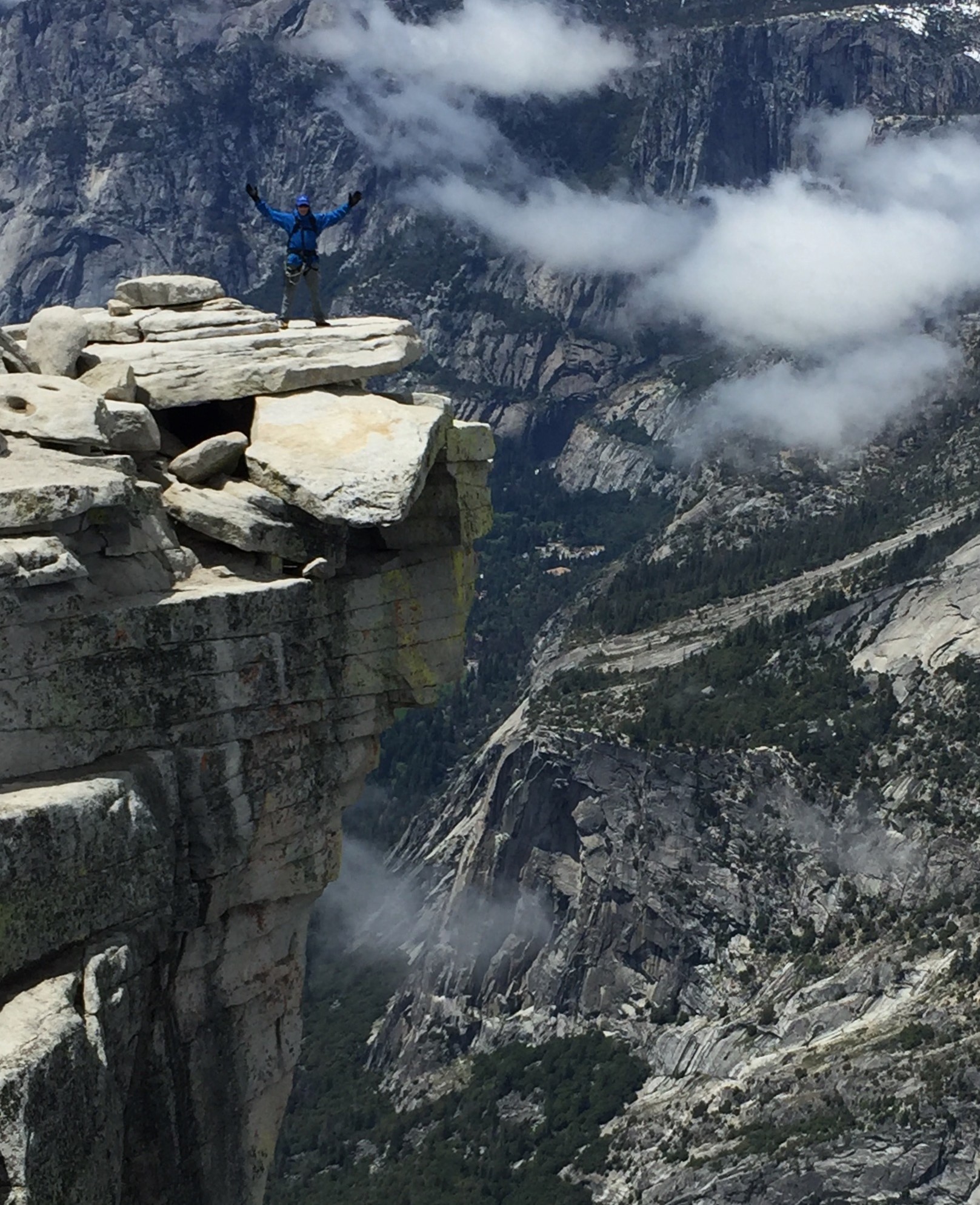
Photo: Steve balanced on the Visor, Half Dome, Yosemite, CA. Credit Charlie Markusen
The trail ends at the bank of the creek. The monsoon-swollen whitewater pours under two twenty-foot-long, four-inch-diameter logs suspended from bank to rocky island. Another set of logs bridges the ten-foot gap from island to the far shore. I have been here before. It is a serious crossing. Falling is not an option. I train for balance on a daily basis. That is why I can step onto a swaying makeshift log bridge, over a flooded Clear Creek, at seventy-two with a twenty-eight-pound pack, expecting to stay dry.
This edition of What I Learned is about balance as a daily practice. I have written about balance in a previous article, A Question of Balance: Staying Upright as You Age. Falls are the leading cause of injury among adults sixty-five and older. A broken hip can end independence. Even a fall without a fracture can steal confidence, and lost confidence leads to less movement. Less movement leads to more falls. Break the cycle.
Balance Systems
Balance depends on three sensory systems: vision, the vestibular system of the inner ear, and proprioceptors throughout the body (especially in the feet and legs) that sense position and movement. Your brain takes in these signals and chooses a strategy to keep you upright.
Your vision system tells your brain where you are relative to your surroundings: the horizon and other fixed reference points. When you start to sway, the visual scene shifts slightly, and your brain uses that shift to trigger a correction. Vision also lets you anticipate. You can see a rock, an icy patch, or a step before you reach it and adjust your posture ahead of time.
The vestibular system is your inner ear’s built-in motion and gravity sensor. It sits next to the cochlea (the hearing part) in each ear, and it tells your brain how your head is moving and which way is down. That information is central to staying upright, keeping your vision steady, and knowing your orientation in space.
The proprioceptive system is your body’s sense of its own position and movement. It’s how you can touch your nose with your eyes closed or walk without watching your feet. For balance, it’s the third leg of the stool alongside vision and the vestibular system, and on firm ground it typically does most of the work.
Proprioceptive information comes from sensors spread throughout your body:
- Muscle spindles: Stretch sensors inside muscles that report how long a muscle is and how fast it’s changing. They’re dense in the ankles, legs, and neck.
- Golgi tendon organs: Sensors where muscles join tendons that report how much force a muscle is producing.
- Joint receptors: Sensors in joint capsules and ligaments that signal joint angle and movement, especially near the ends of a joint’s range.
- Skin pressure receptors: Technically touch rather than pure proprioception, but the soles of your feet are packed with them. They tell your brain how your weight is distributed and when it shifts toward your toes, heels, or edges.
To summarize: vision tells you where you are relative to the world, the vestibular system tells you how your head is moving and which way is down, and proprioception tells you where your body parts are and how your weight is placed on the ground. The brain blends all three and reweights them moment to moment depending on which is most trustworthy. When one system is weak, the others compensate, which is why problems often show up only when a second system is also challenged, like walking on uneven ground in the dark. Try balancing on one foot with your eyes closed.
Every one of these systems declines with age. Your vision has reduced contrast sensitivity and slower focusing. The number of nerve cells in the vestibular system begins to decline around age fifty-five. Proprioception declines as receptors decrease and reaction time slows, and leg strength fades along with it.

Photo: Charlie Markusen balancing on the summit of Teewinot, Grand Teton National Park
Building Balance
The first step is to build balance into your daily routine. Incorporate exercises into your strength training that engage multiple balance systems related to body position, movement, and spatial orientation. Most of my clients are over fifty, and I teach all of them to build balance into the ordinary moments of the day.
Stand on one foot while you brush your teeth. Walk heel to toe down the hallway. Put on your socks standing up. Carry a bag of groceries in one hand to challenge your core. The uneven load forces your trunk to stabilize against tipping sideways. Walk on grass, gravel, and trails instead of flat pavement. Practice Tree pose or Standing Figure Four pose while making your morning coffee.
Standing on one foot on an uneven surface (a Bosu ball or foam pad) is another way to engage several balance systems at once. To increase the challenge, try it with your eyes closed. When you stand on an unstable surface with your eyes closed, you’re relying much more on your vestibular system, so you’re essentially training your brain to use that information more efficiently.
Then add strength. Single-leg exercises are my favorites: pistol squats, single-leg Romanian deadlifts (RDLs), and lunges. Take traditional exercises and do them on single-leg: curl-and-presses, cable rows, and cable chest presses. Add more challenge: do strength exercises standing on a Bosu ball or foam pad. Single-leg exercises build balance and correct the imbalances left behind by old injuries (see Balancing Act: Common Overuse Injuries and Muscle Imbalance). If you have never done these exercises, get help. If I can help, email me at steve.crookedthumb@gmail.com. Safety first.
As you grow stronger and become comfortable doing basic strength and flexibility moves, begin to add load and movement to your balance work. Try a Warrior 3 pose with light hand weights. Do a one-leg RDL with a light kettlebell. Try dynamic balance movements like ice skaters or jumping onto a Bosu ball and holding the landing.
Mix it up. If you do the same thing over and over, you limit your progress, so change your routine periodically. Do something every day. Five minutes a day beats an hour once a month. Challenge yourself with increasing difficulty.
Focus and Balance
Good balance requires focus: being present in the moment. If you are doing one-leg squats on a Bosu ball and start thinking about what needs to get done today, you are off the Bosu. Choose activities that engage you mentally: hiking on uneven ground, cycling (especially mountain biking), cross-country skiing, and paddle boarding. There’s a big overlap between cognition and balance because we have to pay attention, make decisions, adjust our movements, speed up or slow down, and respond to what is happening around us while staying upright.

Photo: Log bridge crossing Clear Creek, Wind River Range, WY
The Payoff
Taking a deep breath to calm my mind, I place a foot on one of the logs. Is it slippery from the rain? No. Does it move when weighted? Yes. Proprioception. The logs are uneven—different sizes, and one hangs lower over the rushing water. Vision. One foot on each log, I alternate steps forward. The logs move independently, challenging my balance in real time. Vestibular. Keeping my eyes on the rock island, ignoring the moving water, keeping my feet in my peripheral vision, I take one slow step at a time. Focus. Halfway to the rocky island, the logs sway a good three inches. There is nothing in my mind except the present.
If you lead an active life and want to stay active as you age, training for balance is not optional. It is required. Don’t rush. Don’t quit. Adventure awaits.
Photo: Another successful adventure complete. Green River Lakes, WY

Leave a Reply